Showing posts with label Dystopian and SciFi. Show all posts

Sunday, August 4, 2013

A Tale of Two Dystopias


Like most people, I loved The Hunger Games. (Team Peeta, thank you very much.) I loved the flawlessness of concept in book one. I loved the focus on inter-generational teamwork and the stirrings of uprising in book two. And I loved the complexities of war and grief in book three. The thing I loved most, though, was Katniss. The very first novel my littlest brother ever read for pleasure (he’s 15 and will be the first to tell you that he most certainly is not a reader) was The Hunger Games. He couldn't stop talking about it for weeks. I’ve never seen him so excited about anything before. And that's why I love Katniss: she's accessible; she flies in the face of all the cries about young boys not wanting to read about girl protagonists.

With all that said, though, The Hunger Games is not actually the book I want to talk about. What I want to talk about is another dystopian YA that I loved even more. A book that I think does what The Hunger Games does, only better: Blood Red Road by Moira Young. 

There are a lot of similarities between these two dystopian stories. First of all, Saba (the protagonist of Blood Red Road) and Katniss are both initially motivated by their love for a sibling. They’re both thrown into circumstances they’re unequal to (essentially, extreme fight or die situations – Katniss in an arena, Saba in a cage). And they both get caught up in a revolution of epic proportions that aims to take down the powers that be.

While having a lot of similarities, though, the two girls are quite different. Katniss is cool and reserved and self-controlled, and while I love this about her, I found these things made it hard for me to relate to her. Saba, on the other hand, is passionate and vulnerable. While Katniss keeps her head down and does what she needs to survive, Saba goes in with her fists up. Saba is all heart and raw emotion and straight-up-in-your-face-fierce.

The other thing I preferred about Blood Red Road was the writing. Both books are told in first person POV. But while Suzanne Collins says it like it is with simple and lyrically-sparse prose, Moira Young is poetic and vivid and Saba’s unpolished voice makes her character and her world bright and alive. For example, this: 

I cain’t speak. Cain’t breathe.
Lugh’s gone.
Gone.
My golden heart is gone.
I kneel in the dust.
The tears roll down my face.
An a hard red rain starts to fall. 

Or this: 

I watch what she does.
I learn fast.
She gives me a helluva beatin before I learn enough. Then I git lucky. I go at her with a flyin kick to the stummick that slams her hard aginst the bars an that’s it. She don’t git up till the keeper pulls her to her feet.
An it’s over. The end.
The end fer her. The beginning fer me.
They don’t tell me her name. There’s a little pink birthmark on her face. It looks like a butterfly.
Like the Cage Master says, it’s a shame when a good fighter goes down to the gauntlet.
But one of us had to.
An it sure as hell warn’t gonna be me. 

See what I mean? Fierce. 

Another awesome thing is that Moira Young is a Canadian living in the U.K. and Saba's world was written to be a kind of dystopian Alberta. Saba’s home of Silverlake is basically the prairies after an ecological apocalypse. Which ties in with the very last reason I prefer this book to The Hunger Games, and that reason is Jack. Don’t get me wrong, I liked Peeta and Gayle. But I didn’t like them the way I liked this guy. Jack is sassy and suave. He's a post-apocalyptic cowboy with mysterious motives, and the chemistry between him and Saba was pitch-perfect.

Also, there were no love triangles - at least not in book one. I can’t say the same about the sequel, however. 

-Kristen

P.S. Read more about Blood Red Road here.

Friday, October 21, 2011

An Interview with Goliath Author Scott Westerfeld!


I LOVE all things steampunk. And I LOVE anything by Scott Westerfeld. So when I laid my hands on Leviathan, the first of his steampunk-inspired, totally amazing series in the fall of 2009, I was smitten. Behemoth came out next, and this fall the conclusion to the series arrived in our little bookstore to much fanfare (mostly from me). Scoot over here to see my review of Goliath to get a feel of what this series is all about.

The good folks at Simon and Schuster Canada set me up with an interview with Scott Westerfeld and his thoughtful answers are reproduced below. It seems much more steampunk to use last names only so Scott is "Mr. Westerfeld", and I will be, um... "Mrs. Sommerfield -Smith" (oh, why not?) So, as they say, tie up your dirigible and stay awhile!

Mrs. Sommerfield-Smith: You’ve done an amazing job of creating a fascinating alternate WWI history in the Leviathan series. You create some great “what if” scenarios and divisions (Clankers vs. Darwinists, boys vs. girls (!)). In your afterword to Leviathan you mention that “the nature of steampunk is blending future and past” and that your series “is as much about possible futures as alternate pasts.” Could you elaborate on this?

Mr. Westerfeld: Steampunk is about messing with history, Victorian history in particular. It's about bringing a flame-thrower to a tea party, while still wearing an appropriate silk cravat. So it's not just a mix of future and past, but of refinement and mayhem.

Mrs. Sommerfield-Smith: Why did you decide to give these novels a steampunk aesthetic? Where did you first encounter steampunk?

Mr. Westerfeld: My first steampunk experience was at Disney World. I was about eight years old, and went on the 20,000 Leagues Under the Sea ride. Something about a nuclear submarine with a pipe organ and baroque stylings really clicked with me. It's that strange mix of technologies and time periods that make certain people love steampunk.


Mrs. Sommerfield-Smith: I’ve noticed steampunk appearing more and more in literature, but also movies and television. Neil Gaiman recently wrote an episode of Doctor Who that had a decidedly steampunk feel. Are there any TV shows with a steampunk look/philosophy that have drawn your attention?


Mr. Westerfeld: I think the movie world (and more recently TV) likes the look and feel of steampunk, but doesn't know what to do with its broader themes yet. Steampunk is about rewriting history, in effect, pushing back the constraints that society placed on people because of their gender or beliefs or who their parents were. And there has yet to be a TV version of steampunk that addresses that larger project. I will admit that I grew up with The Wild, Wild West, however, and that I desperately wanted my own personal gizmo-filled train car.

Mrs. Sommerfield-Smith: In addition to your extremely successful YA series’ you’ve written five science fiction novels for adults. Why did you decide to write for young adults? What are the particular merits of writing for this audience?

Mr. Westerfeld: Teenagers are voracious readers, they send more and better fan mail, and they aren't as limited in their genre choices as adults. But I think the coolest thing about them is how engaged with language they are. At any given moment, more teenagers than adults are studying a foreign language, writing poetry, memorizing song lyrics, and making up slang. Teens are still acquiring language to some extent, and thus they take more joy and interest in the way novels play with words. As a writer who likes to generate slang and other kinds of neologisms, I find them a much more engaged and exciting audience with which to communicate.

Mrs. Sommerfield-Smith: Keith Thompson’s illustrations in the three novels are stunning. I love it when books are illustrated with black and white illustrations. At any time did you and Keith Thompson work together to come up with a “look” for the illustrations, or were writing and illustrating two separate endeavours?

Mr. Westerfeld: I would send Keith first drafts of three or four chapters at a time, and he would respond very quickly with sketches, so we were bouncing back and forth from the beginning. Often I would rewrite based on his illustrations, because I soon found that he was a better engineer than me, and sometimes a better researcher as well. So at times I would be quite general, "Something's going to chase in them in a couple of chapters. Could you draw something fast?" and then let my writing follow his art.

Mrs. Sommerfield-Smith: The internet, do you love it or hate it? Does it help or hinder you as a writer? Are there benefits and/or pitfalls to having a presence online while being an active writer?

Mr. Westerfeld: I think being in touch with readers is a great experience. Teens are wonderfully frank about what they like and dislike in my fiction, which is a really great kind of feedback to get. But the best thing about the internet is the way that teens engage each other, forming communities of readers. And these communities spread outward from the books to the wider world, as with the Harry Potter Alliance and its charitable works. A love of books has always been a way for like-minded people to find each other, and the internet has only made that project more vast and wonderful.

Mrs. Sommerfield-Smith: Your series, Uglies, has a brilliant new sci-fi take on that old (teenage) chestnut: “Be yourself”. In Leviathan, Deryn disguises herself as a boy to join the British Air Force and must be careful not to let her secret slip. I like the fact that you’ve drawn Deryn as an independent, strong-willed young woman, but she’s also not without insecurities and prejudices. What is so unique about this time in a child’s life when they are coming-of-age, and why is it such a fascinating theme to write (and read!) about?

Mr. Westerfeld: I agree that the theme of teenage fiction is Identity. Young people are still figuring out who they are, after all. (Everyone is, really, but teenagers are better at admitting it.) Because the teenage years are filled with epic firsts—first love, first betrayal, first true loss—it's a tremendously dramatic time to write about.

Mrs. Sommerfield-Smith: I like the way the adults in this novel, particularly Dr. Nora Barlow, seem to be positive influences on Deryn and Alek. Was this a conscious choice?

Mr. Westerfeld:I think Barlow and Volger have both positive and negative aspects. They provide a lot of good advice to their young charges, but their overall worldview is one of conflict and competition. Deryn and Alek, on the other hand, are learning the importance of working together across lines of ideology and class. So it's up to my younger characters to separate the good from the bad when it comes to their elders' example and counsel.

Mrs. Sommerfield-Smith: And do you categorize, if you could categorize your books at all, as speculative fiction? If so, what are the freedoms of writing in this genre? Are there any limitations? If not, what sets your books outside the categorization of speculative fiction?

Mr. Westerfeld: I'm lucky in writing for young adults, in that my books don't get categorized as much. I've written science fiction, fantasy, contemporary realism, and now steampunk, and yet all my books can sit happily together in the teen section of the bookstore. And that's all us writers can really ask for, that our books be findable! All the rest of it is for the critics to worry about.

Monday, October 17, 2011

Book Clubbing: *Incarceron* by Catherine Fisher with Bronwyn!


Mandy and her fellow blogger and friend Kiirstin have had a lot of fun "Book Clubbing" on this blog. No, I don't mean violently attacking books with blunt objects (I can already imagine a librarian-led protest rally in response to this), but rather chatting, book-club style, about books they love.

My coworker and friend Bronwyn and I decided to do the latter with the book Incarceron by Catherine Fisher. Bronwyn's read both of the books in the series, Incarceron and Sapphique, so she's supplied me with a little teaser for each:


Incarceron:

In a world thousands of years from now, where everyone lives as though it was still the 17th century, there exists an elaborate prison. Incarceron is so vast that it contains more than cells: metal forests, forgotten cities, vast wilderness, and fog-filled never-ending ravines. Instead of stars at night, the prisoners are followed by glowing red dots, the eyes of the prison that follow their every move. Seventeen-year-old Finn has no memory but believes that he was born outside of Incarceron. He finds a crystal key which allows him to communicate with Claudia. She not only lives outside, she is also the daughter of Incarceron's warden. Finn is determined to escape the prison, and Claudia believes she can help him. But they don't realize that there is more to Incarceron than meets the eye. Escape will take their greatest courage and cost more than they know.


Sapphique:

Without giving too much away, Finn and Claudia are outside together. Finn has discovered that this other world is not what he had hoped for. He must obey rules of protocol and etiquette. His friends are still stuck in Incarceron and he feels that he has abandoned them. They are searching for a magical glove, rumoured to give them the power to escape and join Finn. As the prison prepares to battle, so to does the Outside. The dynamic ending to this book will take your breath away!

***


Bronwyn: Hi Erica!


Erica: Hi Bronwyn!


Bronwyn: How are you doing? Did you get a chance to finish Incarceron?


Erica: Yes. Andrew and I were travelling home from Hamilton yesterday night


and I read a couple of chapters by flashlight. Don't worry, I wasn't the one driving! But,


point being, this book is THAT suspenseful. I couldn't wait to get home to read it.


Bronwyn: I felt the same way. I couldn't wait to finish the book and then I couldn't


wait to read the sequel, Sapphique!


Erica: You recommended that I read this book. What attracted you in the first


place? Why did you pick if off the shelf?


Bronwyn: Well first of all the beautiful cover of that key drew me in. I know as


booksellers we aren't supposed to judge a book by its cover, but I do it all the time.


Then I was really drawn in by this unique idea that Catherine Fisher created in her


book, about a kingdom 3000 years in the future that dresses and acts like they


are living in Versailles and has a prison that is a whole other world that is really an


experiment gone wrong.


Bronwyn: I was also fascinated by the amazing array of gadgets that they use


in the kingdom, things like skin wands to not look old.


Erica: I know! The cover totally drew me in too! You know how much I love anything


steampunk. I opened the front cover and there are a whack of awesome quotes:


"...a steampunk tour de force; ...a gripping futuristic fantasy", etc. So the beautiful


cover and the reviews inside really sold me on this book. The setting (3000 years in


the future, but living as if they are in the 17th century) is very steampunk,


and I found this idea fascinating. The idea that the world is controlled by imposing the


ideals of a former era is brilliant.


Erica: And gadgets! The skin wands reminded me of the the work that Cinna


the stylist did on Katniss in The Hunger Games.


Bronwyn: I also found the main characters -- Finn in the jail and Claudia on "earth" –


very well rounded. I found myself cheering for them and also sometimes a little scared


of them or disappointed in the decisions that they made. I like when an author does that,


when their characters are not superheroes or perfect wonder-beings.


Erica: Yeah, I agree. These characters are well constructed. I liked that Fisher uses the


trope of the princess that is betrothed to an odious prince, and yet Claudia is not the


standard damsel in distress.


Erica: I was also really impressed with the way that Fisher developed the Prison as a


CHARACTER in the novel. The idea of a sentient prison reminded me a bit of the computer


(HAL 9000) in the movie 2001. I think it`s such a scary premise: a prison that is all seeing,


all-knowing and that is responsible for the life and death of its inmates.


Bronwyn: Certainly, Claudia is a woman who knows her own mind and is determined to


get her way. I think she was very empowered, especially because she had been mostly raised


by this master tutor who gave her education, ethics, but mostly taught her how to think


and question the world around her. I have not seen 2001, but I am familiar with the premise.


Sometimes I wonder about that, here we are surrounded by gadgets that we depend on.


Are they all-seeing? Anyways that's a bit too Big Brother. But the books are really built on


that Big Brother premise. And even though in Claudia's world they claim that they are "free",


in fact they are not, there are silent eyes and ears listening to the citizens at all times.


In Incarceron it's obvious when these red eyes are following you wherever you go.


Erica: True. Both Claudia and Finn are each imprisoned in their own way. You could even


argue that Finn's imprisonment is less sinister, because it's right out there. Everyone KNOWS


that Big Brother is watching, so to speak. So I`ve been poking around online and I noticed


that the rights to this book have been optioned and a movie is due out in 2013.


Taylor Lautner and Emma Watson are set to star as Finn and Claudia. What do you think


of this?


Bronwyn: OOOOO that sounds amazing! As I was reading both books I was trying to


figure out how it could be made into a movie because both worlds are so complex, especially


the prison. Incarceron just felt it had all of these layers of worlds contained within it. The


metallic forest that Finn and his group walk through to try and escape the prison, really was


so beautiful, I pictured an enchanted world and then all of a sudden the prison lights go on


and you remember that this is really a jail. A strange (and dare I say wondrous) jail?


Erica: I think that they'll definitely make beautiful movies. The setting is so visually rich


and detailed. The cinematographer's going to have a party. OK. So if the Twilight franchise


has Team Jacob and Team Edward, I propose that there will be a Team Finn vs. Team Jared.


Am I alone in having a bit of a crush on Jared? Tall, dark, handsome Sapient/tutor that


he is?


Bronwyn: I think I would probably be on Team Finn... He definitely seems a "rebel with a


cause". But I can see how Jared is a beguiling character. The second book in the series,


at the very end Jared surprises me, and seems to have a very large character shift.


Bronwyn: Are you planning on reading the second book?


Erica: Definitely. I'm hoping maybe my Jared/Claudia fantasy will be realized in


Sapphique? Haa, just kidding. Too pedagogically inappropriate. No spoilers please.


I just Googled Jared/Incareron/fanfic and the author R.J. Anderson has a series of


fanfiction based on Incarceron.


Bronwyn: Interesting. I am not familiar with fanfiction. What is that?


Erica: It's when fans of a novel or a particular character in a novel take that character


and create their own story and publish it online.It's kind of an outlet for fans to expand


on a story or take characters in a different direction. It’s like a DIY way to make your


favourite stories last longer!


Erica: Here's the link for the R. J. Anderson fanfiction:


http://www.fanfiction.net/s/6795502/1/Th...


Wednesday, September 7, 2011

Review *Ship Breaker* by Paolo Bacigalupi

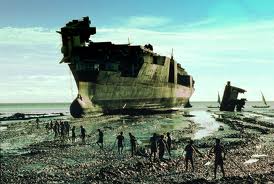
This novel is INTENSE. I was first attracted to the book because of it's awesome cover. The photo here doesn't do it justice: in real life you can clearly see that it is meant to look like weathered metal, probably copper, and the title looks as if it's been etched into the metal. Gorgeous.


Once I got past the cover, the story itself drew me in faster than any book I've read recently.  The story opens in an extremely claustrophobic setting as Nailer, a teenage boy, clambers through a service duct on a grounded oil tanker. Ship Breaker takes place in a future when oil is scarce and discharged oil tankers are docked on the the coast to be broken down for parts. Nailer's job, along with the rest of the teenage crew, is to scavenge copper wiring from grounded ships (thus: ship breaking). Smaller kids like Nailer are preferred for this work, because they can easily navigate the narrow ducts in the tankers.

Listen to this nail-biting description of one of Nailer's salvage missions:

 All around, the duct pinged and creaked. It sank slightly, tilting. The whole thing was on the verge of collapse. Nailer's frantic activity and extra weight had weakened it. ...Metal shrieked. The duct dropped out from under him. Nailer scrabbled for handholds as his world gave away.  His fingers seized scavenged wire. For a second it held, suspending him above an infinite pit. Then the wire tore loose. He plummeted...

Aargh! **bites nails**

Nailer and his friends live in the Gulf Coast region where the worst of the frequent storms that rip along the coast are nicknamed "City Killers": storms so intense that the obliterate anything in their path. In Ship Breaker's dystopian future, global warming is NOW and New Orleans has sunk, twice. I know, know. I hear you saying: "This all sounds terribly grim. Why would I want to read another dystopian YA  novel that's so unrelentlingly BLEAK?" Well, for one, Bacigalupi is an amazing author. I read this book late into the wee hours of the morning because I needed to know what would happen next. Brilliant pacing. And secondly,  as with many dystopian novels, there is a hopeful undercurrent. Nailer's life is all hard knocks and he has an extremely dysfunctional relationship with his dad. His dad is a drug addict who thinks only of when and where his next fix will come from. So, ever resilient, Nailer finds family in his friend Pima and her mother, Sadna.

Family. It was just a word. Nailer could spell it now. Could see all the letters strung together. But it was a symbol, too....Family wasn't any more reliable than marriages or friendships or blood sworn crew , and maybe less. His own father really would gut him if he ever got hold of him again; it didn't matter if they shared blood or not....But Nailer was pretty sure that Sadna would fight for him tooth and nail, and maybe even give up her life to save him.

Nailer ALWAYS finds a way. He never gives up. Sure he falters and stumbles at times, but there's always a will. It's easy to draw similarities between Ship Breaker and The Hunger Games; between Nailer and Katniss. Both Nailer and Katniss are prisoners of circumstance who have to rely upon their own inner resourcefulness. And both books play around with the subject of class, comparing the haves to the have nots. In Ship Breaker's future there is no middle class: the rich are rich and the poor are dirt poor.

I recommend Ship Breaker to anyone who's enjoyed some of the more popular dystopian teen fiction of the last little while: The Maze Runner, The Hunger Games, and Divergent. This is also an excellent novel "for the dudes."


-Erica


Monday, August 15, 2011

"Steampunk is what happens when Goths discover brown..."


This is a photo of author Cherie Priest. Just as I try not to judge a book by it's cover (but I do anyway), I try not to judge an author by her author photo (so I will anyway). This photo is just too much fun. Let's see if we can pin her down.

1) She has blue hair!
2) She is wearing aviator goggles
3) Fingerless gloves. Check.
4) She appears to be posing
in some sort of a steamship/factory/military base

Now, if we add all of these elements together and factor in the major clue in the word "steamship", we can make an educated guess that Cherie Priest is a steampunk fan. The best description of steampunk that I've heard so far is "polite punk", or technology meets romance. For a lengthier definition, see here: http://steampunkscholar.blogspot.com/2009/02/towards-definition-of-steampunk.html

Priest is probably best known for her award-winning steampunk novel, Boneshaker. Dreadnought was written after Boneshaker and has some of the same characters, but it's not necessary to read the books in sequence. So, because Boneshaker was on backorder with the publisher, I decided that to give Dreadnought a go.

Dreadnought is marvellously pulpy, with a remarkable, strong, female character who makes her male counterparts sit up and take notice, thank you very much. Mercy Lynch is whip-smart, sassy and funny. Here's a little sample of her awesomeness:

"It's funny what they say about men in uniform - how people think women just can't resist 'em. Fact is, I think we're just pleased to see a man groomed, bathed, and wearing clothes that fit him."

She knows how to defend herself, is not afraid to travel alone, and is shrewd enough to unravel the mystery at the heart of his story, largely on her own.

Dreadnought takes place during the Civil War (or Priest's version of) and begins with the heroine of the novel, Nurse Mercy Lynch , receiving a telegram informing her that her estranged father is gravely ill. She leaves her post at the hospital and begins the long, dangerous trip across the country, first by zeppelin and them by train. Zeppelin crashes, armoured battle trains, wild-west type ambushes and zombies figure prominently in the a high-energy tale that ensues.

Dreadnought reminded me of everything that was good and smart and fun about Joss "Buffy" Whedon's wild-west television series Firefly. I loved this book and anxiously await the the arrival of Boneshaker!


Friday, January 29, 2010

*Little Brother* Book Clubbing with A Book A Week!

Mostly because I didn't know how to start this review, I went trolling around to see if I could pinpoint exactly what type of SciFi sub-genre Little Brother falls into. It's not exactly apocalyptic or dystopian, but it does fall into the category of "Mundane SF", which "focuses on stories set on or near the Earth, with a believable use of technology and science as it exists at the time the story is written" (wikipedia article, which has more info and links).

Little Brother feels like it's set exactly five minutes from now. Marcus lives in San Francisco and expertly hacks his school's "safety" mechanisms. Like the gait recognition technology--"these idiot cameras that were supposed to be able to tell one person's walk from another"--and "free" student laptops which log, record and analyze every keystroke made. Marcus lives in an alternate Big Brother reality which feels like a few small steps from our own. I don't want to get too pulled away by looking up stuff, but gait recognition technology is already being developed with the intent to use it for a society's apparent safety. And the linked story is two years old.

That's what I really liked about Little Brother--it made me very interested to know how technology may be used against society in the name of communal safety. Cory also presses the point that citizens are the strongest promoters of this safety, justifying the governing body's surveillance as a way to not feel afraid. Or, at least to Marcus, citizens over 25 are most afraid of their safety.

On an afternoon that Marcus and his group ditch school to play this awesome-sounding game called Harajuku Fun Madness, there is a major terrorist attack and he and his three friends are arrested by Homeland Security on suspicion of being terrorists. With no grounds, of course, except for being young, not in school, and in the middle of the attack. But getting back quickly to Harajuku Fun Madness, how amazing does this game sound:
It's an ARG, an Alternate Reality Game, and the story goes that a gang of Japanese fashionteens discovered a miraculous healing gem at the temple in Harajuku, which is basically where cool Japanese teenagers invented every major subculture for the past ten years...They slip the players coded messages that we have to decode and use to track down clues that lead to more coded messages and more clues...Imagine the best afternoon you've ever spent prowling the streets of a city, checking out all the weird people, funny handbills, street maniacs, and funky shops. Now add a scavenger hunt to that, one that requires you to research crazy old films and songs and teen culture from around the world and across time and space. And it's a competition, with the winning team of four taking a grand prize of ten days in Tokyo, chilling on Harajuku bridge, geeking out in Akihabara, and taking home all the Astro Boy merchandise you can eat.

It's when Marcus is checking out a set of GPS coordinates as that day's clue when the attack happens and he and his friends are violently arrested after waving down a military jeep, thinking that the police might help their wounded friend. The few days that Marcus is in some secret jail, after taking a short boat ride, is a turning point in the tone for the story. His imprisonment and humiliation--the absolute power that his captors have over him--fuels Marcus to somehow get back at them for taking his rights. Homeland Security also still have Darryl, or so Marcus believes, and he's commited to freeing his friend.
If I found the surveillance technology neat so far, what is cooler is the description of how Marcus gets around them. Cory has an amazing way of describing technology in super user-friendly ways. He actually made me want to learn how to write code:
If you've never programmed a computer, you should. There's nothing like it in the whole world. When you program a computer, it does exactly what you tell it to do. It's like designing a machine--any machine, like a car, like a faucet, like a gas hinge for a door--using math and instructions. It's awesome in the truest sense: it can fill you with awe.

There is also this very long explanation of how you can rig an Xbox to create a truly secure online connection. The idea comes from a book called Hacking the Xbox, "a wonderful book that tells the story of how bunnie [Andrew "bunnie" Huang], then a student at MIT, reverse-engineered the Xbox's antitampering mechanisms and opened the way for all the subsequent cool hacks for the platform." Actually Cory has a full bibliography of sources for someone who wants to know more about the tech referenced in Little Brother. And even as a person who has little background knowledge, I totally want to know more about security systems, how to use them, and how to hack them. It was the funnest part about this book--I want to read everything Cory read before he wrote it.

*****
Followed by an early morning chat with Kiirstin from A Book A Week, on Little Brother:

Mandy: I liked your review, it was spot-on.

kiirstin: Thank you! I liked yours as well. You seemed to focus more on the technological aspects than I did. I didn't realize, for example, that gait recognition tech was something people were already working on.

Mandy: I was inspired to do some further reading, which is what I hope people would do after reading the book. My further reading was Google related, but I love that Cory included some fantastic resources at the end of his book for anyone interested.

kiirstin: Absolutely. And the essays by others at the end, I thought that was a neat touch.

Mandy: Gait-recognition technology sounds so silly after reading LB. It makes no sense. I love that LB made me question something that might otherwise seem like an okay technology to develop.

kiirstin: I thought he was very tech neutral, in some ways. Not necessarily saying "this is a bad technology" but "it is stupid to use technology in this way." Also, it made me decide I'd better password protect my cell phone.

Mandy: Many times throughout the book I was like "hunh?" about the techno-talk, but I'm used to that in SciFi. What is so cool about LB, and "mundane SciFi" in general, is that the techno-talk is not techno-babble; terms made up and used for plot purposes in some SciFi.

All of his explanations made perfect sense and were well researched. He also explained things very vividly.

kiirstin: Which all leads to that creepy "um, yeah, this could actually happen. yikes" feeling, because the technology behind the story was so established.

Mandy: Completely. You could see it all happening. LB did make me more paranoid in general--which was a big theme in the book. It also made me want to hack my Xbox with my zero hacker knowledge, but exuberant interest.

kiirstin: I think making you a bit paranoid's exactly what it was supposed to do. Even the times where I felt it might be a bit over the top, part of me was whispering that it wasn't really that over the top.

And then there was that thing on the border with the SciFi author who got the crap kicked out of him by border guards, like, a week after I finished the book.

Mandy: I didn't know about that. Who was the author?

kiirstin: Dr. Peter Watts. The first article I read about it was at Making Light. The comments on that post are really wonderful to read, too. Cory Doctorow was the first one to really break the news about that one. Dr. Watts is a friend of his.

Mandy: Cory is the coolest.

I love that his book was impeccably researched. He really knows his stuff. It's great to see someone who has a real message and gets it across, even in fiction.

Not to denigrate fiction, of course, as I love reading it. A heavy dose of non-fiction is great, though, and a bit of a breath of fresh surveilled air compared to many contemporary YA books.

kiirstin: There's a lot of fluff out there, which of course is wonderful to read too, but LB definitely had meat to it.

He just felt so familiar with the subject material. Although... if I can admit... that was one of the small things that kind of bugged me every once in a while.

Mandy: At times it was too much for me, as well.

kiirstin: It was just sometimes that there was such a clear agenda. While I agree wholeheartedly with the agenda, it was still quite noticeable.

Mandy: I agree. It was a little heavy-handed. I did like how he brings up the question, a few times in the book, how can you tell the difference between the good guys and the bad guys? Both know how to hack but the good guys are the ones who use it for a "good" purpose. However, who's the judge of that?

He touches on this a few times. I would have liked him to bring this to the fore a little more in the book.

kiirstin: Oh yes! Definitely. I liked what he did with that but I did want a bit more. The thing with Marcus' father was interesting -- I think any parent reading that would understand Marcus' father's perspective perfectly.

He was like the walking question "How much freedom and privacy would you give up to protect your family." And I *know* for many people it would be "all of it" except that without a bigger picture it's hard to recognize that by giving up those things, you're also harming your family.

Mandy: And the question of security was huge in the book. But when does the need for a sense of security become a means to possibly "evil" ends? Can we ever attain the type of security we're so set on keeping?

kiirstin: For example, how far are we willing to go just to catch wankers who decide that putting explosives in their underwear is the ideal way to inspire terror?

At the risk of overloading, there's another great Making Light thread talking about that issue. The point that is made somewhere in there is that there will *always* be outliers that we will never be able to predict.

Mandy: The lengths that we'd HAVE to go, according to LB, would only be "good" for the whole, not the individual and then you get on the slippery slope of means to the end for the greater good, which sometimes bulldozes the individual. And Homeland Security in the book demands that predictability be the norm. Which is crazy to suggest. And desperate to maintain.

kiirstin: Yes, exactly! Actually, something that stuck with me about that even though I didn't write it down was an offhand comment made about a kid who was HIV positive and his parents didn't know. And because of DHS' movement-watching scheme, they flagged his (her?) movements and blew his cover. Which would quite possibly have ruined his life.

Actually, this is something we've started having to deal with in libraries. In the States, their have been a couple of cases where the DHS has wanted libraries to release patron records to see what someone who is suspicious has been checking out of the library.

Mandy: I've heard of the library records cases. Crazy.

I also love the theme of Don't Trust Anyone Over 25. Because in the book anyone over 25 doesn't trust them. It's a theme that's interesting; the latter generation doesn't trust the newer generation because they are the next world-makers. What if they aren't right for the job?

"What if we haven't taught them the right way of being in the world and now it will come back to haunt us?" = blanket mistrust.

kiirstin: That whole blanket mistrust is SO PREVALENT though. Even some parents don't trust the kids they've raised to make good decisions. And true, teenagers sometimes make stupid decisions. But adults also often make stupid decisions, and they're the ones with the power.

I really liked that push-back.

Thanks, K!


Pop over to Kiirstin's blog for HER side of the story!

Mandy

Friday, January 15, 2010

*How I Live Now* by Meg Rosoff -- A Re-reading Retrospective!


"It would be much easier to tell this story if it were all about a chaste and perfect love between Two Children Against the World at an Extreme Time in History but let’s face it that would be a load of crap"

How I Live Now, like other really great books, is a world of its own.

It’s also Meg’s first book, which renders me agog. Her sister’s death from cancer was the impetus to write, and at the time HILN was slated for publication she herself was diagnosed with the disease. I have read a few interviews with Meg and I have this sense of her as a lady who rightfully sees doubt and fear as huge impediments to life. The world that Daisy finds herself living in is one where you live day by day, and at times hour by hour. Meg has a wise and wide perspective and it makes HILN a deeply resonant book.

"I like writing for and about teens because it's a very extreme time of life, and that makes for intense transformations, intense possibilities for growth. I think many people find their teens a difficult and disturbing time, but also a time of great excitement and intensity. As a writer, you can't ask for a better set-up than that."
(Biography.jrank.org referencing source on Bookbrowse.com)

Daisy is 15 and on top of the intense transformational period of being a teen, she finds herself in the explosive transformative time of war. The book opens with her arrival in England, self-exiled from her dad’s home in New York, leaving behind a new step-mom and step-sister. She intends on staying with cousins she’s never met and the sister of her deceased mother. What she finds is a sprawling home in the countryside and a wonderfully unruly gang of kids who smoke and drive and make her feel more like herself then she ever remembers feeling.

Reading this book again I anticipated my favourite scenes being replayed. One of my excitements is the first time Daisy sees the house, which “is practically indescribable if the only sort of houses you’ve lived in before are apartments in New York City.” There is this garden—actually wildness and growing things are a huge part of the imagery during the first part of the story—that appears again at the end of the book and had me captivated a second time:

Climbing up the front of the house is a huge vine with a stem so thick it must have been growing there for hundreds of years but there aren’t any flowers on it yet, I guess because it’s too early. Behind the house and up some stone steps is a square garden surrounded by high brick walls and in there are tons of flowers blooming already all in shades of white. In one corner there’s a stone angel about the size of a child, very worn, with folded wings and Piper told me it was a child who lived in the house hundreds of years ago and is buried in the garden.

From an interview with Meg we did last May, I asked her about the child in the garden because I loved the imagery and what it suggested. She said that, “The angel in the garden was originally thrown in as a casual detail, but I found I liked what it suggested and added another reference to it at the end. Take your pick -- the death of innocence, the reminder that in the midst of life we are in death (to coin a phrase), mortality juxtaposed with rebirth (the bulbs and the roses in the garden) and also a little reminder to Daisy that she is not the centre of the universe -- that people have lived and died before she was even born.”

When the garden pops back up at the end of the story I was so excited and it gave me goosebumps. With a second reading the way that flora and fauna weave through the story is so vivid and perfect. Also one of my favourite scenes is the picnic that the cousins have just before their lives change. In the first part of the book these kids live outside time in a visceral and romantic connection to nature. It was very vivid for me:

We got to a place by a river and parked the jeep and got out and Isaac carried all the fishing stuff, and Edmond brought lunch and a blanket to lie on and although the day wasn’t very warm, I made a nest for myself by trampling down a little patch in the tall grass and put the blanket down and lay very still and as the sun rose up in the sky I warmed up even more and all I could hear was the sound of Edmond talking in a steady low stream of conversation to the fish, and Piper singing her odd song, and the occasional splash of the river or a bird rising into the air near us and singing its heart out.

I was thinking about almost nothing except that bird and then Edmond was next to my ear whispering Skylark, and I just nodded, knowing it was futile to ask how he knew the answers to questions you hadn’t even got around to asking yet.

There’s this magical realism in the book that I really enjoyed. It was more like Magic Realism Light, I suppose. Piper, Edmond and his twin Isaac share this unspoken connection with each other and with animals. Almost like they can read each other’s minds. Interestingly, Osbert, their older brother who goes all Hitler Youth, doesn’t connect with them in this way, or even close. Daisy finds a strong connection with Edmond, even when they are far apart. There is this amazing scene where Piper refuses to go back into their house near the end because of the ghosts, and even Daisy can still hear echoes of their old life and of the people who were in the house. Daisy is wandering around and is describing the unreal feel of home after wartime.
And while Daisy and Edmond are separated, Daisy *knows* that he is still alive. She sometimes gets a sense of what he's seeing and feeling. Although this connection is not ultimate, as seen when Edmond's mind and heart are lost to what he's experienced, which Daisy believes, must have been far worse than what she and Piper had witnessed. Meg writes about this connection very beautifully and believably.

When I read HILN for the first time this year I thought it was set in WWII. The back cover mentions a war and I just assumed, probably because it's such a hot topic for fiction. Then I did a double-take when Daisy talks about cell phone reception. It's funny, even when Edmond picks her up at the airport he seems to be a creature out of another time period. He smokes, he's assured, and way older than he seems. I kept forgetting his actual age, which I believe is like 12-13 (?), younger than Daisy for sure. Enough to make her very aware that, had they not been living virtually parent-less in a beautiful countryside house which seems to stand outside of time, there would be nothing "Okay" about their romance. Although they weren't very "romantic" with each other. There was a sweetness and a sense of first discovery--what it would feel like to find out you have a twin, and he/she's beautiful, and you know it's wrong but *everything* in the world is absolutely wrong right at this moment, so hey.
I keep seeing HILN labelled Dystopian and on Dystopian book lists and such. And I get it because the war that erupts, or rather infiltrates slowly and feeds on confusion and fear, isn't any war in particular. HILN feels like the setting could be five minutes from now. Meg mentions that the war in the book is a pastiche of modern conflicts, including WWII, but not limited to it. HILN isn't historical fiction but a story that talks about our future. The way that war will be fought--the breakdown in technology and our dependence on it. So in this way I can see it as Dystopian. The pervading fear and helplessness that sets in once all electrical communication ends is very quick. People turn on each other and no one knows what's going on.
I really enjoyed re-reading How I Live Now. I knew what was going to happen so I was able to soften my focus and catch the subtleties. There is so much in this book that I haven't covered, which is one of the downfalls of writing a spoiler-free review! There's so much to take away.
HILN really sticks with you.
What did you think of it? I'm excited to see your comments!
Mandy

LinkWithin

Related Posts with Thumbnails