Showing posts with label For the Dudes. Show all posts

Wednesday, January 18, 2012

The fault, dear Brutus, is not in our stars...


John Green, with misplaced manuscript

Sixteen-year-old Hazel Grace has stage four cancer that is spreading to her lungs. Thanks to a hopeful new trial drug, the growth of her cancer has been halted for a time. At a cancer support group meeting to help her deal with her depression,  Hazel meets Augustus Waters, a handsome, charming young man whose own cancer prognosis looks better than Hazel’s. Hazel is drawn to Augustus' sense of humour, unique worldview and thorough grasp of irony and metaphor. Augustus has a weird habit of dangling an unlit cigarette between his lips, but later explains: “It's a metaphor, see. You put the killing thing right between your teeth, but you don't give it the power to do its killing.” Hazel’s relationship with Augustus and their shared love of a book called An Imperial Affliction by a reclusive Dutch writer named Peter van Houten take them along an unusual path of self-discovery.

Beautifully written and filled with humour, The Fault in Our Stars is also one of the most highly anticipated Young Adult titles this year. And it’s no wonder. It’s author, John Green, has almost two million followers on Twitter (http://twitter.com/realjohngreen) and a whole community of nerdy fans at vlogbrothers (http://www.youtube.com/vlogbrothers) , a collection of video journals that are a back and forth correspondence with his brother Hank. The videologs are caffeine-fuelled musings on just about everything worth talking about. It’s not an exaggeration to say that Green’s fans are of the die-hard variety, regularly posting encouraging comments on his website like “I can’t wait to receive my signed, pre-ordered copy of your new book so I can lick your signature!” OK, maybe no one actually said that, but you get the idea.

The new book does NOT disappoint. The plot and topic of this new book was a closely-guarded secret with Green and his publishers for a while, so I had no idea what this one was about. John Green could sell his shopping lists on ebay and make a fortune so it almost seemed like what he chose to write about was irrelevant. But here’s the kicker: The Fault in Our Stars is about one of the single most difficult topics around: childhood cancer. In a lesser writer’s hands, this would be the kind of book I would diligently avoid; however, this is why it’s not a problem:

1)      John Green’s previous (and award-winning) book Looking for Alaska deals with death in a sensitive, intelligent, and even, at times, humorous way.
2)      Green writes teenage dialogue good enough to make Joss Whedon (Buffy) and Amy Sherman-Palladino (Gilmore Girls) sit up and take notice.
3)     The Fault in Our Stars is filled with lots of literary references and poetry. I love that Green never assumes that his audience is stupid.

The Fault in Our Stars will be a feast for existing John Green fans, and--for new readers--a great introduction to a young adult writer at the top of his game.


-Erica

Friday, October 21, 2011

An Interview with Goliath Author Scott Westerfeld!


I LOVE all things steampunk. And I LOVE anything by Scott Westerfeld. So when I laid my hands on Leviathan, the first of his steampunk-inspired, totally amazing series in the fall of 2009, I was smitten. Behemoth came out next, and this fall the conclusion to the series arrived in our little bookstore to much fanfare (mostly from me). Scoot over here to see my review of Goliath to get a feel of what this series is all about.

The good folks at Simon and Schuster Canada set me up with an interview with Scott Westerfeld and his thoughtful answers are reproduced below. It seems much more steampunk to use last names only so Scott is "Mr. Westerfeld", and I will be, um... "Mrs. Sommerfield -Smith" (oh, why not?) So, as they say, tie up your dirigible and stay awhile!

Mrs. Sommerfield-Smith: You’ve done an amazing job of creating a fascinating alternate WWI history in the Leviathan series. You create some great “what if” scenarios and divisions (Clankers vs. Darwinists, boys vs. girls (!)). In your afterword to Leviathan you mention that “the nature of steampunk is blending future and past” and that your series “is as much about possible futures as alternate pasts.” Could you elaborate on this?

Mr. Westerfeld: Steampunk is about messing with history, Victorian history in particular. It's about bringing a flame-thrower to a tea party, while still wearing an appropriate silk cravat. So it's not just a mix of future and past, but of refinement and mayhem.

Mrs. Sommerfield-Smith: Why did you decide to give these novels a steampunk aesthetic? Where did you first encounter steampunk?

Mr. Westerfeld: My first steampunk experience was at Disney World. I was about eight years old, and went on the 20,000 Leagues Under the Sea ride. Something about a nuclear submarine with a pipe organ and baroque stylings really clicked with me. It's that strange mix of technologies and time periods that make certain people love steampunk.


Mrs. Sommerfield-Smith: I’ve noticed steampunk appearing more and more in literature, but also movies and television. Neil Gaiman recently wrote an episode of Doctor Who that had a decidedly steampunk feel. Are there any TV shows with a steampunk look/philosophy that have drawn your attention?


Mr. Westerfeld: I think the movie world (and more recently TV) likes the look and feel of steampunk, but doesn't know what to do with its broader themes yet. Steampunk is about rewriting history, in effect, pushing back the constraints that society placed on people because of their gender or beliefs or who their parents were. And there has yet to be a TV version of steampunk that addresses that larger project. I will admit that I grew up with The Wild, Wild West, however, and that I desperately wanted my own personal gizmo-filled train car.

Mrs. Sommerfield-Smith: In addition to your extremely successful YA series’ you’ve written five science fiction novels for adults. Why did you decide to write for young adults? What are the particular merits of writing for this audience?

Mr. Westerfeld: Teenagers are voracious readers, they send more and better fan mail, and they aren't as limited in their genre choices as adults. But I think the coolest thing about them is how engaged with language they are. At any given moment, more teenagers than adults are studying a foreign language, writing poetry, memorizing song lyrics, and making up slang. Teens are still acquiring language to some extent, and thus they take more joy and interest in the way novels play with words. As a writer who likes to generate slang and other kinds of neologisms, I find them a much more engaged and exciting audience with which to communicate.

Mrs. Sommerfield-Smith: Keith Thompson’s illustrations in the three novels are stunning. I love it when books are illustrated with black and white illustrations. At any time did you and Keith Thompson work together to come up with a “look” for the illustrations, or were writing and illustrating two separate endeavours?

Mr. Westerfeld: I would send Keith first drafts of three or four chapters at a time, and he would respond very quickly with sketches, so we were bouncing back and forth from the beginning. Often I would rewrite based on his illustrations, because I soon found that he was a better engineer than me, and sometimes a better researcher as well. So at times I would be quite general, "Something's going to chase in them in a couple of chapters. Could you draw something fast?" and then let my writing follow his art.

Mrs. Sommerfield-Smith: The internet, do you love it or hate it? Does it help or hinder you as a writer? Are there benefits and/or pitfalls to having a presence online while being an active writer?

Mr. Westerfeld: I think being in touch with readers is a great experience. Teens are wonderfully frank about what they like and dislike in my fiction, which is a really great kind of feedback to get. But the best thing about the internet is the way that teens engage each other, forming communities of readers. And these communities spread outward from the books to the wider world, as with the Harry Potter Alliance and its charitable works. A love of books has always been a way for like-minded people to find each other, and the internet has only made that project more vast and wonderful.

Mrs. Sommerfield-Smith: Your series, Uglies, has a brilliant new sci-fi take on that old (teenage) chestnut: “Be yourself”. In Leviathan, Deryn disguises herself as a boy to join the British Air Force and must be careful not to let her secret slip. I like the fact that you’ve drawn Deryn as an independent, strong-willed young woman, but she’s also not without insecurities and prejudices. What is so unique about this time in a child’s life when they are coming-of-age, and why is it such a fascinating theme to write (and read!) about?

Mr. Westerfeld: I agree that the theme of teenage fiction is Identity. Young people are still figuring out who they are, after all. (Everyone is, really, but teenagers are better at admitting it.) Because the teenage years are filled with epic firsts—first love, first betrayal, first true loss—it's a tremendously dramatic time to write about.

Mrs. Sommerfield-Smith: I like the way the adults in this novel, particularly Dr. Nora Barlow, seem to be positive influences on Deryn and Alek. Was this a conscious choice?

Mr. Westerfeld:I think Barlow and Volger have both positive and negative aspects. They provide a lot of good advice to their young charges, but their overall worldview is one of conflict and competition. Deryn and Alek, on the other hand, are learning the importance of working together across lines of ideology and class. So it's up to my younger characters to separate the good from the bad when it comes to their elders' example and counsel.

Mrs. Sommerfield-Smith: And do you categorize, if you could categorize your books at all, as speculative fiction? If so, what are the freedoms of writing in this genre? Are there any limitations? If not, what sets your books outside the categorization of speculative fiction?

Mr. Westerfeld: I'm lucky in writing for young adults, in that my books don't get categorized as much. I've written science fiction, fantasy, contemporary realism, and now steampunk, and yet all my books can sit happily together in the teen section of the bookstore. And that's all us writers can really ask for, that our books be findable! All the rest of it is for the critics to worry about.

Monday, October 3, 2011

Goliath!

Goliath is the conclusion to the Young Adult trilogy, Leviathan. I whipped through the first two books in this series, Leviathan and Behemoth, so you can imagine how excited I was when I received an advance copy of Goliath.

The Leviathan trilogy is a steampunk-inspired alternate history of World War I. The series’ main characters are Alek, heir-in hiding to the Austrian throne and son of the murdered Archduke Franz Ferdinand and Princess Sophie, and Deryn Sharp, a young girl from London who dreams of being part of the British Air Service. Deryn sneaks her way in to the service by pretending to be a boy and by calling herself Dylan Sharp. In Westerfeld’s version of WWI, there are two main opposing factions: the Clankers and the Darwinists. The Clankers are countries, such as Germany and Austria-Hungary, that use steam-driven iron machines for warfare. The Darwinists use altered animals as their weaponry. Darwinists countries include Britain, France and Japan.

The three novels follow Alek and Deryn’s adventures aboard the airship Leviathan, a huge vehicle made out of a whale and an intricate ecosystem unto itself. On top of some thrilling combat with huge steampunk iron machines and some daring escapes, lies a budding romance between Alek and Deryn that builds throughout the series. Admittedly, the feelings are a little one-sided in the first two novels. As Deryn is disguised as a boy, admitting her feelings for Alek would be like admitting that her whole existence as a soldier has been a lie.

And if all this still doesn’t sell you on what a thrilling series this is, Keith Thompson’s black and white illustrations throughout the book are fantastically intricate depictions of the huge beasties and clankers. I found myself flipping ahead in each book to look at the next illustration, despite the major spoilers!

Behemoth and the entire Leviathan trilogy will appeal to teenagers and adults alike, especially history buffs and steampunk enthusiasts. A great series for teen boys who are reluctant readers, too.

-Erica

Wednesday, September 7, 2011

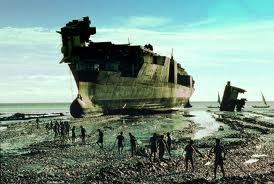
Review *Ship Breaker* by Paolo Bacigalupi

This novel is INTENSE. I was first attracted to the book because of it's awesome cover. The photo here doesn't do it justice: in real life you can clearly see that it is meant to look like weathered metal, probably copper, and the title looks as if it's been etched into the metal. Gorgeous.


Once I got past the cover, the story itself drew me in faster than any book I've read recently.  The story opens in an extremely claustrophobic setting as Nailer, a teenage boy, clambers through a service duct on a grounded oil tanker. Ship Breaker takes place in a future when oil is scarce and discharged oil tankers are docked on the the coast to be broken down for parts. Nailer's job, along with the rest of the teenage crew, is to scavenge copper wiring from grounded ships (thus: ship breaking). Smaller kids like Nailer are preferred for this work, because they can easily navigate the narrow ducts in the tankers.

Listen to this nail-biting description of one of Nailer's salvage missions:

 All around, the duct pinged and creaked. It sank slightly, tilting. The whole thing was on the verge of collapse. Nailer's frantic activity and extra weight had weakened it. ...Metal shrieked. The duct dropped out from under him. Nailer scrabbled for handholds as his world gave away.  His fingers seized scavenged wire. For a second it held, suspending him above an infinite pit. Then the wire tore loose. He plummeted...

Aargh! **bites nails**

Nailer and his friends live in the Gulf Coast region where the worst of the frequent storms that rip along the coast are nicknamed "City Killers": storms so intense that the obliterate anything in their path. In Ship Breaker's dystopian future, global warming is NOW and New Orleans has sunk, twice. I know, know. I hear you saying: "This all sounds terribly grim. Why would I want to read another dystopian YA  novel that's so unrelentlingly BLEAK?" Well, for one, Bacigalupi is an amazing author. I read this book late into the wee hours of the morning because I needed to know what would happen next. Brilliant pacing. And secondly,  as with many dystopian novels, there is a hopeful undercurrent. Nailer's life is all hard knocks and he has an extremely dysfunctional relationship with his dad. His dad is a drug addict who thinks only of when and where his next fix will come from. So, ever resilient, Nailer finds family in his friend Pima and her mother, Sadna.

Family. It was just a word. Nailer could spell it now. Could see all the letters strung together. But it was a symbol, too....Family wasn't any more reliable than marriages or friendships or blood sworn crew , and maybe less. His own father really would gut him if he ever got hold of him again; it didn't matter if they shared blood or not....But Nailer was pretty sure that Sadna would fight for him tooth and nail, and maybe even give up her life to save him.

Nailer ALWAYS finds a way. He never gives up. Sure he falters and stumbles at times, but there's always a will. It's easy to draw similarities between Ship Breaker and The Hunger Games; between Nailer and Katniss. Both Nailer and Katniss are prisoners of circumstance who have to rely upon their own inner resourcefulness. And both books play around with the subject of class, comparing the haves to the have nots. In Ship Breaker's future there is no middle class: the rich are rich and the poor are dirt poor.

I recommend Ship Breaker to anyone who's enjoyed some of the more popular dystopian teen fiction of the last little while: The Maze Runner, The Hunger Games, and Divergent. This is also an excellent novel "for the dudes."


-Erica


Sunday, February 21, 2010

Review *White Cat: The Curse Workers #1* by Holly Black


White Cat is the first in a new series called The Curse Workers, and my first time reading Holly Black. Who very much surprised me, I have to say. I think that Holly and Francesca Lia Block could be buddies; I just see a definite similar sensibility in their writing styles.

White Cat opens with Cassel Sharpe having sleepwalked out of his dormroom and onto the roof. It's actually a pretty great scene. Cassel's sharp wit and vulnerability come across in the writing immediately, and I love that he calls out for help even though he knows it makes him less manly:

"Help," I say softly, and feel crazy nervous laughter bubble up my throat. I bite the inside of my cheek to tamp it down.
I can't ask for help. I can't call anyone. If I do, then my carefully maintained pretense that I'm just a regular guy is going to fade forever. Sleepwalking is kid's stuff, weird and embarassing.

Except, once he's helped down from the roof, he's kicked out of school. It's no secret that his whole family are Curse Workers, his grandfather having been a death worker for the powerful Zacharov family. Cassel has never shown signs that he's inherited his family's worker gene, but the school thinks that maybe he's been cursed himself, on account of the shady dealings his family is associated with. Because although it is not illegal to have the ability to work, actually using your abilities to victimize others in any way is definitely illegal. Cassel's mother is in jail for this reason.

One of the coolest things about the world in White Cat is the notion and complexity of curse working. Bits of its history and rules are offered throughout the book, but there's no full-on explanation for its existence, or how some people have access to these abilities. People go around wearing gloves to protect themselves from skin contact, or if they're a worker, to show that they mean no threat to others. Traditionally a curse is transferred via the hands, and can only be countered by charms--bits of stone that have been created by workers to offer protection to the wearer:

Charms to throw off curse work, charms like the ones Audrey has hanging around her neck, are as old as curses themselves. Workers make them by cursing stone--the only material that absorbs a whole curse, including the blowback. Then that stone is primed and will swallow up a curse of the same type. So if a luck worker curses a piece of jade and wears it against her skin, and then someone tries to curse her with bad luck, the jade breaks and she's not affected. You have to get another charm each time you're worked, and you have to have one for each type of magic, but you're safe.

There's so much background info about curses and charms and how everything functions, the type of society that would grow around a world with this magic in it. Holly works * har har * this into the story flawlessly and even attempts to explain the ability to work in a scientific frame.

Getting back to Cassel's entry into the story, he tells the reader, in a Noirish way that permeates the tone of the story:

Don't be too sympathetic. Here's the essential truth about me: I killed a girl when I was fourteen. Her name was Lila, she was my best friend, and I loved her. I killed her anyway. There's a lot of the murder that seems like a blur, but my brothers found me standing over her body with blood on my hands and a weird smile tugging at my mouth. What I remember most is the feeling I had looking down at Lila--the giddy glee of having gotten away with something.

Lila was a dream worker and Cassel just expects that his nightmares and sleepwalking are just a part of his guilt. Until he starts digging through his family's secrets and finds out there's way more going on to Lila's death than he remembers.

One thing that surprised me about the story was that there was no main love interest theme. It's kind of about Cassel's resourcefulness and wit, regardless of not being a worker with special abilities. He's a bookie at his school and a smartass, and his comebacks are hilarious. But he's not exactly cocky. I wasn't annoyed by his personality. I was interested to see how he'd scheme his way out of the tight situations his family puts him in. He's the baby of the family and has to be the strongest because of it. His family members are nuts. Except for his grandpa, who is probably my favourite character. Here's a great exchange between them:

"I need to talk to you," I say, taking out a mug and pouring milk into it first, then adding the coffee. The milk billows up from the bottom, along with flecks of dust I should have probably checked for. "I had a weird dream."
"Let me guess. You got tied up by lady ninjas. With big hooters."
"Uh, no." I take a sip of the coffee and wince. Grandad made it ridiculously strong.
My grandfather shoves a strip of bacon in his mouth with a grin. "Guess it would have been kind of weird if we'd had the same dream."

Holly is a very strong writer when it comes to characters and dialogue. One of my favourite scenes is when Cassel goes to see Crooked Annie, a sharp, wizened fortuneteller who's real business is selling powerful charms. The dialogue is perfect, the back and forth between them. The scene is so vivid and really gives a lot of unspoken information about Cassel and his growing concern that his family is conning him.
The ending was not what I expected and was left a little up-in-the-air. There are two more books slated for the series and I can't imagine where the story will go from here. White Cat is a great choice for the dudes, too.

Mandy

Monday, February 8, 2010

Review *The Secret Year* by Jennifer Hubbard


Julia was killed on Labor Day on her way home from a party. I didn't get to see her that night. I used to meet her on Friday nights, but I was never invited to the parties that she was invited to. We'd meet on the banks of the river, clutch at each other in the backseat of her car, steam up her windows and write messages and jokes to each other in the fog on the glass, and argue about whether to turn on the A/C. Sometimes we swam in the river late at night when the water was black and no one could see us. We did all that for a year, and nobody else knew.

The Secret Year opens a few hours after Julia dies in a car accident. Colt hears about it through his best friend, Syd, who heard it from Kirby, a girl who straddles the social divide between Black Mountain Road kids and people from The Flats. Colt has to act uninvolved as he wrings details from Syd: He and Julia were the only two people who knew about their affair. Now it is just him. When Michael, Julia's brother, hands Colt a journal of letters she's kept for him, it's the only connection he has to the girl he lost.

The story follows Colt for about a year after Julia's death, as he reads her letters/journal and tries to piece together the year they spent together in secret. Julia has a boyfriend, and she lives up on Black Mountain Road with the rich elite. Colt is from The Flats. He gets to the theme of their story right away, telling us:

That was the biggest difference between Julia and me: Black Mountain versus the flats. Not that we were Romeo and Juliet or anything. Nobody was trying to keep us apart. My family wouldn't have cared if I'd gone out with her. Julia's family probably would've hated me, but they wouldn't have locked her in her room. It was what her friends would've thought that bothered her, I think.

A cool image in the book is the river where Colt and Julia go on Friday nights to be together. They meet at night and the river looks black. After her death Colt goes there to be alone. I was looking around Jennifer's blog and I found an entry mentioning her fascination with "the river cure" mentioned by Anais Nin in one of her journals:

Described a[s a] folk cure for madness that involved placing a person next to a flowing river. The person was supposed to throw a stone into the river to unlock any blocked feelings, so that the feelings could flow again. I was not aware of this before I wrote my book, but it certainly reminded me of Colt. (Yes, there’s even a scene where he throws stones in the water.) Whether he succeeds in healing his “madness” and unlocking all the secrets that bound him to Julia, I leave you to discover. (Class of 2k10)

Another important character goes to the river when she wants to think or be alone, too. Although I don't remember the part where Colt throws a stone into the water. I DO remember the first time he kisses Julia. She's waded in wearing a slip and she teases him to come in with her. And he does. It surprises her. I liked in the book how the river was like a test of character; it attracts a certain type of person who can identify this river-attraction in others. It was well-done.

The Secret Year isn't exactly a romance novel, either. Which is the sense I initially got from the cover. Colt's interest in Julia after her death, I felt, was very natural. Kirby kind of throws it in his face a bit, like he's drawing it out too much by holding on to her journal. But I disagree. Their relationship wasn't perfect or really normal, but it was passionate and real at the time. Colt takes the year after her death to really process what she was to him and subsequently what he represented to her. Jennifer has this great blog post talking about how romance in a novel can bring out vulnerabilities in the characters, and I think this makes total sense for the "romance" in the book. Julia has flaws and only retrospect showed Colt that she wasn't exactly who she seemed. I wouldn't call their connection romantic, or really any other relationship Colt has with girls afterwards, as much as it's about two people finding out more about themselves through the eyes of another.

It's funny. This review is kind of short. I enjoyed reading the book but it was more like something to experience than to pick apart. It's very character-driven, which I like, and I enjoyed the central mystery of finding out who exactly Julia Vernon is and what her last night was like.

Mandy

Recently:

Review of Book One of The Vampire Diaries by L.J. Smith
Review of Book Two of The Vampire Diaries (I've been on a kick)
A funny take on judging books by their cover
A review of Possessed by Kate Cann (to show that I can write an okay review :) )

Friday, January 29, 2010

*Little Brother* Book Clubbing with A Book A Week!

Mostly because I didn't know how to start this review, I went trolling around to see if I could pinpoint exactly what type of SciFi sub-genre Little Brother falls into. It's not exactly apocalyptic or dystopian, but it does fall into the category of "Mundane SF", which "focuses on stories set on or near the Earth, with a believable use of technology and science as it exists at the time the story is written" (wikipedia article, which has more info and links).

Little Brother feels like it's set exactly five minutes from now. Marcus lives in San Francisco and expertly hacks his school's "safety" mechanisms. Like the gait recognition technology--"these idiot cameras that were supposed to be able to tell one person's walk from another"--and "free" student laptops which log, record and analyze every keystroke made. Marcus lives in an alternate Big Brother reality which feels like a few small steps from our own. I don't want to get too pulled away by looking up stuff, but gait recognition technology is already being developed with the intent to use it for a society's apparent safety. And the linked story is two years old.

That's what I really liked about Little Brother--it made me very interested to know how technology may be used against society in the name of communal safety. Cory also presses the point that citizens are the strongest promoters of this safety, justifying the governing body's surveillance as a way to not feel afraid. Or, at least to Marcus, citizens over 25 are most afraid of their safety.

On an afternoon that Marcus and his group ditch school to play this awesome-sounding game called Harajuku Fun Madness, there is a major terrorist attack and he and his three friends are arrested by Homeland Security on suspicion of being terrorists. With no grounds, of course, except for being young, not in school, and in the middle of the attack. But getting back quickly to Harajuku Fun Madness, how amazing does this game sound:
It's an ARG, an Alternate Reality Game, and the story goes that a gang of Japanese fashionteens discovered a miraculous healing gem at the temple in Harajuku, which is basically where cool Japanese teenagers invented every major subculture for the past ten years...They slip the players coded messages that we have to decode and use to track down clues that lead to more coded messages and more clues...Imagine the best afternoon you've ever spent prowling the streets of a city, checking out all the weird people, funny handbills, street maniacs, and funky shops. Now add a scavenger hunt to that, one that requires you to research crazy old films and songs and teen culture from around the world and across time and space. And it's a competition, with the winning team of four taking a grand prize of ten days in Tokyo, chilling on Harajuku bridge, geeking out in Akihabara, and taking home all the Astro Boy merchandise you can eat.

It's when Marcus is checking out a set of GPS coordinates as that day's clue when the attack happens and he and his friends are violently arrested after waving down a military jeep, thinking that the police might help their wounded friend. The few days that Marcus is in some secret jail, after taking a short boat ride, is a turning point in the tone for the story. His imprisonment and humiliation--the absolute power that his captors have over him--fuels Marcus to somehow get back at them for taking his rights. Homeland Security also still have Darryl, or so Marcus believes, and he's commited to freeing his friend.
If I found the surveillance technology neat so far, what is cooler is the description of how Marcus gets around them. Cory has an amazing way of describing technology in super user-friendly ways. He actually made me want to learn how to write code:
If you've never programmed a computer, you should. There's nothing like it in the whole world. When you program a computer, it does exactly what you tell it to do. It's like designing a machine--any machine, like a car, like a faucet, like a gas hinge for a door--using math and instructions. It's awesome in the truest sense: it can fill you with awe.

There is also this very long explanation of how you can rig an Xbox to create a truly secure online connection. The idea comes from a book called Hacking the Xbox, "a wonderful book that tells the story of how bunnie [Andrew "bunnie" Huang], then a student at MIT, reverse-engineered the Xbox's antitampering mechanisms and opened the way for all the subsequent cool hacks for the platform." Actually Cory has a full bibliography of sources for someone who wants to know more about the tech referenced in Little Brother. And even as a person who has little background knowledge, I totally want to know more about security systems, how to use them, and how to hack them. It was the funnest part about this book--I want to read everything Cory read before he wrote it.

*****
Followed by an early morning chat with Kiirstin from A Book A Week, on Little Brother:

Mandy: I liked your review, it was spot-on.

kiirstin: Thank you! I liked yours as well. You seemed to focus more on the technological aspects than I did. I didn't realize, for example, that gait recognition tech was something people were already working on.

Mandy: I was inspired to do some further reading, which is what I hope people would do after reading the book. My further reading was Google related, but I love that Cory included some fantastic resources at the end of his book for anyone interested.

kiirstin: Absolutely. And the essays by others at the end, I thought that was a neat touch.

Mandy: Gait-recognition technology sounds so silly after reading LB. It makes no sense. I love that LB made me question something that might otherwise seem like an okay technology to develop.

kiirstin: I thought he was very tech neutral, in some ways. Not necessarily saying "this is a bad technology" but "it is stupid to use technology in this way." Also, it made me decide I'd better password protect my cell phone.

Mandy: Many times throughout the book I was like "hunh?" about the techno-talk, but I'm used to that in SciFi. What is so cool about LB, and "mundane SciFi" in general, is that the techno-talk is not techno-babble; terms made up and used for plot purposes in some SciFi.

All of his explanations made perfect sense and were well researched. He also explained things very vividly.

kiirstin: Which all leads to that creepy "um, yeah, this could actually happen. yikes" feeling, because the technology behind the story was so established.

Mandy: Completely. You could see it all happening. LB did make me more paranoid in general--which was a big theme in the book. It also made me want to hack my Xbox with my zero hacker knowledge, but exuberant interest.

kiirstin: I think making you a bit paranoid's exactly what it was supposed to do. Even the times where I felt it might be a bit over the top, part of me was whispering that it wasn't really that over the top.

And then there was that thing on the border with the SciFi author who got the crap kicked out of him by border guards, like, a week after I finished the book.

Mandy: I didn't know about that. Who was the author?

kiirstin: Dr. Peter Watts. The first article I read about it was at Making Light. The comments on that post are really wonderful to read, too. Cory Doctorow was the first one to really break the news about that one. Dr. Watts is a friend of his.

Mandy: Cory is the coolest.

I love that his book was impeccably researched. He really knows his stuff. It's great to see someone who has a real message and gets it across, even in fiction.

Not to denigrate fiction, of course, as I love reading it. A heavy dose of non-fiction is great, though, and a bit of a breath of fresh surveilled air compared to many contemporary YA books.

kiirstin: There's a lot of fluff out there, which of course is wonderful to read too, but LB definitely had meat to it.

He just felt so familiar with the subject material. Although... if I can admit... that was one of the small things that kind of bugged me every once in a while.

Mandy: At times it was too much for me, as well.

kiirstin: It was just sometimes that there was such a clear agenda. While I agree wholeheartedly with the agenda, it was still quite noticeable.

Mandy: I agree. It was a little heavy-handed. I did like how he brings up the question, a few times in the book, how can you tell the difference between the good guys and the bad guys? Both know how to hack but the good guys are the ones who use it for a "good" purpose. However, who's the judge of that?

He touches on this a few times. I would have liked him to bring this to the fore a little more in the book.

kiirstin: Oh yes! Definitely. I liked what he did with that but I did want a bit more. The thing with Marcus' father was interesting -- I think any parent reading that would understand Marcus' father's perspective perfectly.

He was like the walking question "How much freedom and privacy would you give up to protect your family." And I *know* for many people it would be "all of it" except that without a bigger picture it's hard to recognize that by giving up those things, you're also harming your family.

Mandy: And the question of security was huge in the book. But when does the need for a sense of security become a means to possibly "evil" ends? Can we ever attain the type of security we're so set on keeping?

kiirstin: For example, how far are we willing to go just to catch wankers who decide that putting explosives in their underwear is the ideal way to inspire terror?

At the risk of overloading, there's another great Making Light thread talking about that issue. The point that is made somewhere in there is that there will *always* be outliers that we will never be able to predict.

Mandy: The lengths that we'd HAVE to go, according to LB, would only be "good" for the whole, not the individual and then you get on the slippery slope of means to the end for the greater good, which sometimes bulldozes the individual. And Homeland Security in the book demands that predictability be the norm. Which is crazy to suggest. And desperate to maintain.

kiirstin: Yes, exactly! Actually, something that stuck with me about that even though I didn't write it down was an offhand comment made about a kid who was HIV positive and his parents didn't know. And because of DHS' movement-watching scheme, they flagged his (her?) movements and blew his cover. Which would quite possibly have ruined his life.

Actually, this is something we've started having to deal with in libraries. In the States, their have been a couple of cases where the DHS has wanted libraries to release patron records to see what someone who is suspicious has been checking out of the library.

Mandy: I've heard of the library records cases. Crazy.

I also love the theme of Don't Trust Anyone Over 25. Because in the book anyone over 25 doesn't trust them. It's a theme that's interesting; the latter generation doesn't trust the newer generation because they are the next world-makers. What if they aren't right for the job?

"What if we haven't taught them the right way of being in the world and now it will come back to haunt us?" = blanket mistrust.

kiirstin: That whole blanket mistrust is SO PREVALENT though. Even some parents don't trust the kids they've raised to make good decisions. And true, teenagers sometimes make stupid decisions. But adults also often make stupid decisions, and they're the ones with the power.

I really liked that push-back.

Thanks, K!


Pop over to Kiirstin's blog for HER side of the story!

Mandy

Thursday, August 20, 2009

Review *Everlost*


Yesterday was a great reading day for me. I had the day off *bliss* and I sat in a favourite coffee place finishing off Everlost. Then I read half of Harry, A History by Leaky Cauldron fansite lady Melissa Anelli and started Going Bovine by Libba Bray (which I realize now is 500 pages; I audibly gulped). So a pretty good day.

From Neal Shusterman's website (this blog is turning into a shrine!):

IT BEGINS WITH AN ACCIDENT.
Nick and Allie don't survive the crash, and now their souls are stuck halfway between life and death in a sort of limbo called Everlost. It's a magical yet dangerous place, where bands of lost souls run wild and anyone who stands in the same spot too long sinks to the center of the Earth. Frightened and determined, Nick and Allie aren't ready to rest in peace just yet. They want their lives back, and their search for a way home will take them deep into the uncharted areas of Everlost. But the longer they stay, the more they forget about their pasts. And if all memory of home is lost, they may never escape this strange, terrible world.

My Reading Experience:

It's funny because this description and the cover of the book don't give away anything of the developing plot and the structure and depth this story takes on. Everlost is intended for younger readers than Neal's newest book, Unwind, and you can tell that in a way while you're reading. But at the same time I was struck by how sophisticated the story became. I wouldn't hesitate to convince a 17 year-old to read Everlost.

It starts simply. Nick and Allie, travelling in separate cars, collide and are thrown from their vehicles. They wake up in a forest and standing over them is a strange and exited boy who says he's been trying to wake them for 9 months! When they finally realize their situation, they set off to find answers and try to get home. But the world of Everlost is a lot more complex, and a lot more menacing, than it seems at first.

I was surprised by how imaginative Nick and Allie's world became. Everlost is a kind of dystopian, Lord of the Flies, Peter Pan place where only kids under the age of 15 "live". The explanation, given by Everlost's guardian Mary Hightower, or Mary Queen of Snots, is that adults have a fixed idea of the afterlife and usually get where they're going whereas kids are more easily thrown off path.

Mary Hightower is a very neat character and has an interesting role in Everlost. She has collected children and keeps them safe, from monsters or sinking into the earth. She has also written more books than anyone can read about their world and how to exist in it. Except, once Allie notices a few glaring discoveries about Mary, she leaves to find her own answers.

My only qualm is with the convoluted ending. It kind of ends on a flatter note, with a lot of action and confusion and a few things pulled out of nowhere. But, it is the first of a trilogy (the second is available November '09), and you can feel that by the not-completely-satisfying ending. Otherwise, the characters are totally engaging, and the mystery of Everlost keeps you reading. There are a lot of gems in this book, just like in Unwind, and it is a satisfying read.

Excerpts:

In her book, You're Dead--So Now What?, Mary Hightower offers the following warning for the restless soul: "Wanderlust is a dangerous thing. In Everlost there's safety in staying put. Afterlights who are cursed with a desire to travel don't last for long. They either succumb to Gravity Fatigue, of they are captured by feral packs of unsavory children. The few that escape these fates become Finders, but the existence of a Finder is full of peril. Better to seek a safe haven, and stay there. And if you haven't found a safe haven, by all means, come see me"

and

In her book, Everything Mary Says Is Wrong, Allie the Outcast writes: "There are mysteries in Everlost. Some of them are wonderful, and others are scary. They should all be explored, though-perhaps that's why we're here; to experience the good and the bad that Everlost has to offer. I really don't know why we didn't get where we were going, but I do know this much: being trapped doing the same thing over and over again for all time is no way to spend eternity--and anyone who tells you so is wrong"

I forgot to mention how funny Everlost can be, too.

Mandy

You might also like:

Wednesday, August 19, 2009

My Favourite Reads *Unwind*

Right now I'm reading Everlost by Neal Shusterman and I'm reminded of how much I love his books! Which is funny because the only other one I've read is Unwind. But, when I finished it last year, even while I was reading it, I had this sense that I would pretty much follow Neal anywhere storywise. So, knowing that the sequel, Everwild, is soon to be released (Nov '09), I started reading the first of the Skinjacker trilogy. But today I want to talk about Unwind as one of My Favourite Reads.

From Neal Shusterman's website:

In a society where unwanted teens are salvaged for their body parts, three runaways fight the system that would "unwind" them Connor's parents want to be rid of him because he's a troublemaker. Risa has no parents and is being unwound to cut orphanage costs. Lev's unwinding has been planned since his birth, as part of his family's strict religion. Brought together by chance, and kept together by desperation, these three unlikely companions make a harrowing cross-country journey, knowing their lives hang in the balance. If they can survive until their eighteenth birthday, they can't be harmed -- but when every piece of them, from their hands to their hearts, are wanted by a world gone mad, eighteen seems far, far away.

Why it is a favourite read:

I started reading Unwind because the cover was so awesome. Also, I pretty much pick up anything that seems in anyway science fiction or dystopian for teens, which is an aftereffect of experiencing Ender's Game at a tender age. And, the thing that I'm realizing with Neal's books is that yes, he hooks you initially with a gripping premise--kids meticulously taken apart piece by piece but still legally alive as a way to salvage unwanted social outcasts--but he doesn't just ride this one narrative hook. He completely explores any and all themes associated, through a cast of well-written and memorable characters. So you have the idea that a person's body parts can be used to help others; What are the specific implications for a person not choosing this fate? What about people who DO choose to unwind themselves for possibly religious reasons? What about the people who, instead of using salvaged body parts to help them live, decide they just want nicer teeth? Also, how do these new body parts affect their owners?

Neal explores every possible ramification of his premise, he doesn't just go "oh, here's something that will catch them, now I just have to sit back and let the adventure plot do the work". He thinks about all of the ways the idea of unwinding could affect people and their lives, and he explores each idea through his characters. Unwind is very thoughtful and crafted. And I remember actually being surprised by this, by finding this type of attention to detail in Unwind. It was being marketed as an adventure, and it IS, but it is also a lot more.

Whenever I point this book out to my customers I have to downplay the dark nature of the premise. Maybe it's because it is usually parents coming in for books for their kids, but I find most adults unsettled by the idea behind Unwind. If a younger reader was browsing, he or she would probably be more apt to pick it up. Or see it in the library and find it attractive. But I actually get the gruesome-reeling-back face from adults. Although one lady told me that she didn't want to pick the book up for her teen because she worried that he would see her as the type to volunteer him for the process, and she herself said it wouldn't be out of character for her. I peered closer, waiting for the "just kidding", but it didn't come. It is to his credit that Neal writes books for his intended audience and not for their parents.
And now Everlost has me hooked.
Mandy

My Favourite Reads is a weekly meme hosted by At Home With Books

Sunday, August 16, 2009

Review *How to Steal a Car*

Pete Hautman is one of my top 5 favourite authors. I say that without telling you who the other four would be only because I want it left open-ended. I just want you to know that I've read a lot and that a top 5 placement means something. I like Pete Hautman books more than I like anything written by John Green, Libba Bray, Chris Lynch. Hautman is on par with Cecil Castellucci, in my heart. Again, that's saying a lot.

So I was ecstatic when I received a copy of his newest, How to Steal a Car, in the mail this week. Seeing as I didn't even know a newest was available! And it has a great little cover; little cop car figures chasing down a red convertible. All of my reading took a back seat to my time with this book. Which turned out to be no time at all as I read it in 24 hours.

I devoured it so quickly for two reasons. One, it's a good, gripping read. It doesn't let you put it down. Kelleigh, like the heroine of Sweetblood, is a delicious mystery as a person. In the opening scene she's witnessed a man drop his car keys at the mall, and she picks them up and keeps them. The rest of the novel is almost an explanation for her actions. But the story never comes right out and tells you what's going on in Kelleigh's head. It works its way around the story, circling closer and closer to the "real" story of who Kelleigh is. And Hautman is a master of narrative involution. It's what keeps me coming back.

And two, I don't actually think this book is more than 200 pages, so it was a quick read. But, when I finished, my first thought was "I wish this was 70 pages longer". I wanted more of the story. Nothing is missing and it has a satisfying ending, the characters are all fleshed out; this is a full story. But I wanted more. I wanted more, specifically about the situation leading up to the fate of Kelleigh's parents. I wanted more passages written about Kelleigh's homework reading, Moby Dick, and how it connected with her experiences. I wanted more of her own essay she's working on, How to Steal a Car.

Don't get me wrong. I was not dissatisfied with the story. It is an addictive read. It has all of the elements I truly loved in Sweetblood, Godless, Invisible. I just wanted that same story to last a little longer.

Although her role is largely off-screen my favourite character is Kelleigh's grandma, the hippie pregnant teen, one-time (that we know of) car thief. I love how Kelleigh digs up her past after her death and connects with her in a way she couldn't when she was alive. This piece fits in so perfectly in the book.

But I encourage you to check out Pete's blog and website. I hope he won't mind but I've scavenged this video of him reading from his book. It's really great! Top 5!


Mandy

I also truly recommend:
Sweetblood by Pete Hautman

Actually, I've decided to make this review an impromptu giveaway. I want to give away a copy of Sweetblood and How to Steal a Car to a lucky winner. Please leave your name and e-mail to enter!

Thursday, August 13, 2009

Half World by Hiromi Goto

Half World by Hiromi Goto, beautifully illustrated by Jillian Tamaki

From the publisher:

Melanie Tamaki is an outsider.
Unpopular and impoverished, she is the only child of a loving but neglectful mother. She barely copes with surviving school and life. But everything changes on the day she returns home to find her mother is missing, lured back to Half World by a vile creature calling himself Mr. Glueskin. Soon Melanie embarks on an epic and darkly fantastical journey to Half World to save her mother. What she does not yet realize is that the state of the universe is at stake....


My reading experience:

The cover art is gorgeous; the front jacket folds out for a panoramic image of two Melanies in different stages of her journey. Jillian Tamaki does an incomparable job of illustrating Melanie from references in the story, which is refreshing for YA cover art. The colours are so vivid and there is so much movement in the cover. It attracted me to the book initially, even though I only had an advanced reading copy (which does not wraparound and does not have any of Tamaki's illustrations inside!). Good thing I never got to reading it until it was released! I was missing much of the connection between the illustrations and the narrative; at times pictures will show you what was written down for Melanie to read, which isn't actually written in the text. It gives you the magical feel that Melanie must have when she's discovering these messages as part of the story.

Melanie's story starts at the very beginning for her; her mother is pregnant with her in Half World and she and Melanie's father are scrambling along a cliff, persued by Mr. Glueskin and his freakish posse. They are trying to bridge the divide between Half World and Life (our world) so their baby can live. Half World is like purgatory, a place to go when you die. However, because of past events, the divide between Life, Half World, and Spirit World have become too solid, causing the denizens of HW to remain stuck there, trapped in their most traumatic emotional memories and living them over and over again, unable to move on. The opening scene with Melanie's parents and their flee from Mr. Glueskin, Mr. Glueskin's introduction and their sacrifice, make for wonderfully gripping narrative. It was a great way to start a book.

Horomi Goto's strength is for seemlessly weaving folktale, mythic, dream, and art history images, creating this narrative collage in her setting and characters. And the character of Mr. Glueskin is a formidable bad guy who reminded me of the Pale Man from Pan's Labyrinth. Which is actually a good reference point for Half World; Pan's Labyrinth meets Bosch, Frida Kahlo, Escher, with a dash of A Wrinkle in Time (which I've just read. What a cool experience to have read these two books so close together). And Half World is a very grown up book, with Melanie dealing openly with the nature of true despair and sacrifice. However, HW ends on a hopeful note despite the darkness that came before. Absolutely, there is light in this book.

Here is the dust jacket unfolded, courtesy of hiromigoto.com.

Mandy

You might also like to see:
Half World Trailer
Teaser Tuesday Half World
Review and Book Giveaway for A Wrinkle in Time

Thursday, August 6, 2009

The Space Between by Don Aker

I think that Don Aker took one of those creative writing classes which teach you to open your book with a bang:

I’m going to Mexico to get laid.

And he does. Well, he has strong intentions. What soon-to-be-turning eighteen year-old Jace doesn’t know is that life has a way of churning up the best intentions, leaving him to sort through what’s left.
Jace loves his family but travelling with his mom, his lushy aunt, and autistic brother will make it near impossible for him to achieve his goal at the Mexican resort, the Mayan Empress. When his aunt rents him his own room at the resort, he can’t believe his luck. But the only person he seems to attract to his company is the jerk jock, Connor, who is travelling with his raucous team mates.

And that’s the plot in a nutshell. But it doesn’t touch Jace’s real story, the one that unfurls slowly and takes on more colour as Jace learns what it really means to become a man. The excellence to this book is in Jace’s voice. I could feel Don Aker channelling his teenage self through the character with a touch of his more objective, adult perspective. But only a touch. Aker threads the best use of dirty words and expletives I’ve read since King Dork. The Space Between rests somewhere in between the styles of Frank Portman and John Green, with a heavier Green leaning. If you read this book just to experience the world through Jace, it will have been well worth the read.

That said, I have a few problems with the plot turns. There’s nothing outrageous that happens (which I tend to hate; *spoiler* like for example Renee being the killer in True Blood season one—what a betrayal of an awesome character and also a stupid narrative decision even if it is supported by the book), but some of the events seemed harried or two-dimensional. Or see-through; please find genuine ways of getting the character from point A to point B, emotionally. And for the most part, Aker does, I mean I read this book like a crazywoman up at 7:00 a.m. just to get a good 150 pages in before work.
I wish I could quote some of the awesome use of bad words and their combinations from the book but I assume that I’m in polite company! You won’t necessarily bust a gut, but you’ll yell HA! (one of my own many ways of laughing) and attempt to Aker-ize your everyday conversation. Be warned!

Mandy

Previously:
Teaser Tuesday of The Space Between

LinkWithin

Related Posts with Thumbnails